
Whisker Fatigue in Cats: What the Research Actually Says
This post contains affiliate links. If you buy through them we may earn a small commission, at no extra cost to you. Learn more.
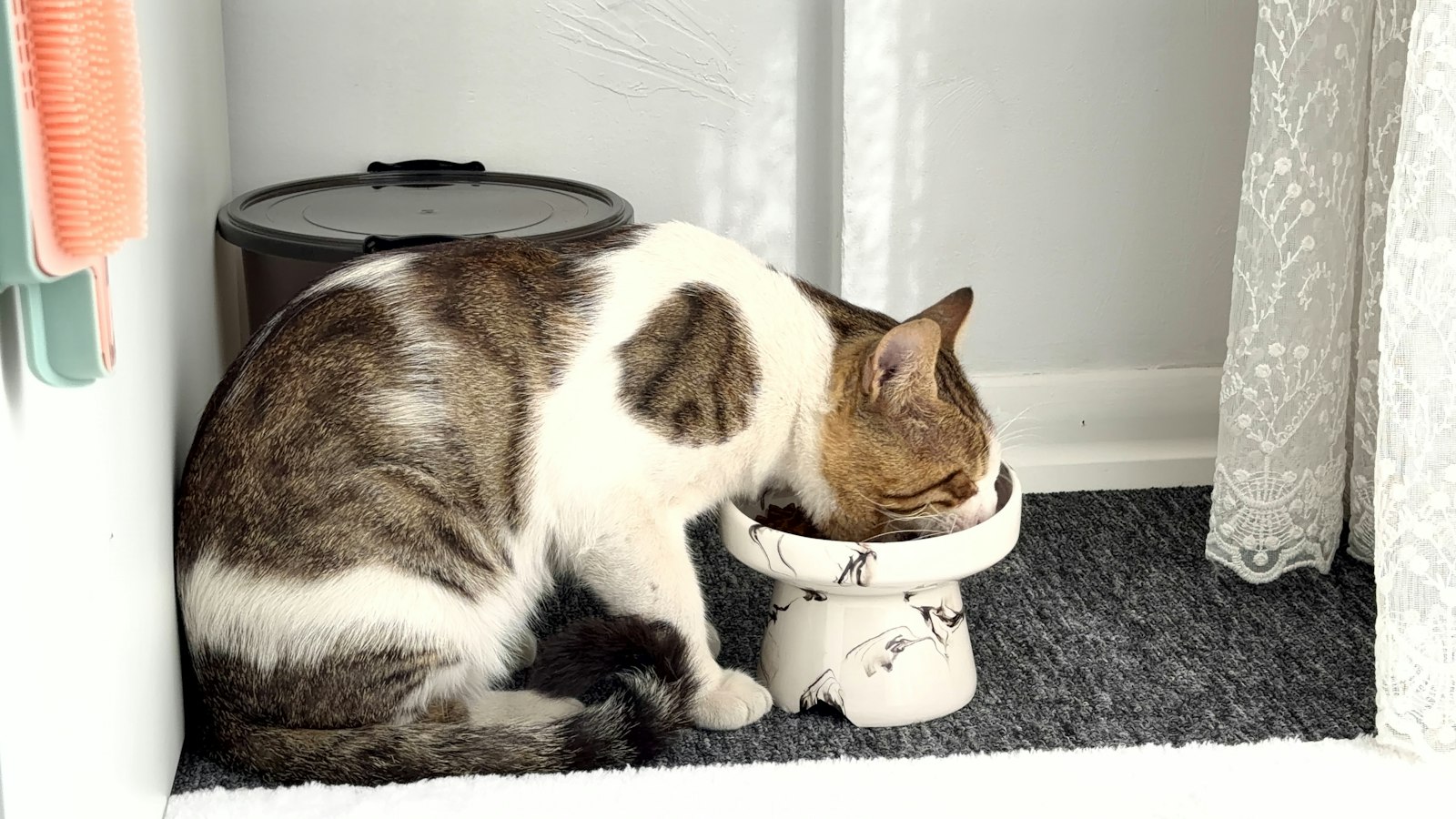
Whisker fatigue is the idea that a cat’s whiskers get overstimulated when they brush the sides of a narrow, deep bowl, making mealtimes stressful. It’s a popular explanation for cats that paw food onto the floor or leave half a meal, and it sells a lot of “whisker-friendly” dishes. But it isn’t a recognized diagnosis, and the research behind it is thin.
This guide covers what whiskers do, what the one controlled study on whisker-friendly bowls found, which mealtime changes deserve a vet visit instead, and how to choose a bowl your cat is comfortable with without overthinking it.
The short answer
- Whisker fatigue is unproven. A 2020 review of feline feeding research found “no empirical evidence” that whisker stress occurs.
- The one controlled study found no effect on eating. In 38 cats, a shallow whisker-friendly dish didn’t change how long cats ate, how much they ate or how much they dropped.
- Many cats still preferred the shallow dish. Given both bowls side by side, 24 of the 38 cats chose the whisker-friendly one.
- A change in appetite is a vet question first. Pawing at food or eating less can have medical causes that a new bowl won’t fix.
- A wide, shallow dish is a cheap, harmless thing to try. Offer it next to the old bowl and let your cat choose.
What are cat whiskers for?
Whiskers are sensory tools, not just long hairs. Each one sits in a follicle–sinus complex, a specialized structure with its own blood supply and nerve connections that carries touch information from the face to the brain. Cats use them to judge space and read their surroundings, which is why it seemed plausible to researchers that constant contact with a bowl could be unpleasant (Slovak and Foster, 2020).
Plausible isn’t the same as proven, though. The same paper notes that the term “whisker stress” appears only in commentary and opinion pieces, not in clinical research.
Is whisker fatigue real?
There’s no good evidence that it is. Writing in Veterinary Clinics of North America, feline behavior researchers Mikel Delgado and Leticia Dantas describe whisker stress as “the assumed discomfort experienced when a cat’s whiskers touch the side of a narrow bowl while eating” and state that “to date there is no empirical evidence on whether whisker stress occurs” (Delgado and Dantas, 2020). Their practical advice is simple: offer food in a few different styles of dish and see whether your cat shows a preference.
That doesn’t prove whisker fatigue is a myth either. It means nobody has shown it happens, and the only study designed to look for it didn’t find it.
What did the whisker-friendly bowl study find?
The study, by Jennifer Slovak and Taylor Foster at Washington State University, is the only controlled test of whisker-friendly bowls so far (Slovak and Foster, 2020).
How it worked. Forty healthy indoor cats aged 1 to 12, all eating dry food from a ceramic or stainless steel bowl, were enrolled; 38 finished. Owners fasted each cat for 12 hours, then filmed it eating its normal meal from its usual bowl for up to 5 minutes and counted the kibble eaten and dropped. Each cat then ate from a commercial whisker-friendly dish in the same material for a week before the test was repeated. On the last day, owners put both dishes down together to see which one the cat chose.
The dishes. Every cat’s usual bowl was narrower and deeper than the study dishes. The ceramic whisker-friendly dish measured 14 × 15 cm and 3.5 cm deep (about 5.5 × 6 inches and 1.4 inches deep); the stainless steel one was 10 × 19 cm and just 1 cm deep (about 4 × 7.5 inches and 0.4 inches deep).
What changed. Nothing measurable:
| Measure | Whisker-friendly dish | Usual bowl |
|---|---|---|
| Food eaten (cups, mean) | 0.22 | 0.21 |
| Time at the bowl (seconds, mean) | 198 | 209 |
| Kibble dropped (pieces, mean) | 14.3 | 1 |
None of these differences was statistically significant. If anything, more kibble ended up outside the flat dishes on average, though the numbers varied a lot from cat to cat.
What cats chose. Given both dishes side by side, 24 cats picked the whisker-friendly dish, 9 picked their usual bowl and 5 showed no preference.
The limits. The authors are upfront about them: 38 cats is a small group, owners couldn’t be blinded to which dish was which, each meal was filmed for only 5 minutes, and the 12-hour fast may have made hungry cats ignore any discomfort. They also suggest older cats may have simply got used to their bowls. So the study is weak evidence in both directions. It didn’t find whisker fatigue, and it can’t rule it out.
What are the signs people link to whisker fatigue?
Articles about whisker fatigue usually list behaviors like these at mealtime:
- pawing food out of the bowl and eating it off the floor
- eating only from the middle of the bowl and leaving food around the edges
- hovering by the bowl, looking hungry, but not eating much
- seeming tense or irritable around meals
The trouble is that none of these is specific to whiskers. A cat may simply prefer a different dish shape, as many in the study did. More importantly, eating less can be a medical sign. Delgado and Dantas warn that a reduced appetite “can be caused by a diversity of pathological or disease processes” and shouldn’t be treated as normal pickiness until health problems have been ruled out (Delgado and Dantas, 2020).
When should you see a vet instead?
Book a vet visit before buying a new bowl if your cat:
- is eating noticeably less, or has stopped eating
- is losing weight
- has changed its eating habits suddenly, rather than always eating this way
A new dish can’t fix a health problem, and a bowl swap can hide one for a while. If your vet gives the all-clear and your cat still seems fussy at the bowl, then it’s worth experimenting with dishes.
How to choose a bowl your cat likes
You don’t need to prove whisker fatigue exists to give your cat a dish it prefers. The study’s own method makes a good home test.
- Go wide and shallow. A dish wider than your cat’s whiskers and no deeper than a few centimeters, like the ones in the study, is the safe bet. A flat plate or saucer works as a free trial before you buy anything.
- Offer a choice. Put the new dish next to the old bowl for a few meals and watch which one your cat goes to first. That’s exactly what the researchers did, and what Delgado and Dantas recommend.
- Pick an easy-clean material. Both study dishes were ceramic or stainless steel. Food and water bowls should be washed daily: Delgado and Dantas point out that pet bowls rank among the most bacteria-laden surfaces in the kitchen, and a dirty bowl may put a cat off its food.
- Think about where the bowl goes, not just what it is. Position bowls so your cat can see who’s approaching while it eats, away from busy walkways.
- Give each cat its own spot. In multi-cat homes, Delgado and Dantas recommend feeding cats at least a few feet apart, so each one can choose to eat alone. Cats that have to share a bowl may eat while stressed, or wait and go hungry.
A note on raised bowls: they’re popular, and a bowl at a comfortable height may suit an older or stiff cat. But the whisker study didn’t test height, so there’s no research showing that raised bowls prevent whisker fatigue.
Mealtime is one part of your cat’s setup. For the others, see what cats want from a litter box and why they need safe high places.
FAQ
Is whisker fatigue real?
It hasn’t been shown to be. A 2020 veterinary review found no empirical evidence that whisker stress occurs, and the only controlled study found that whisker-friendly dishes didn’t change how much cats ate, how long they ate or how much they dropped. Many cats in that study still preferred the shallow dish, so a wider bowl is a harmless thing to try.
What does whisker fatigue look like?
The behaviors usually blamed on it are pawing food out of the bowl, eating only from the middle, and hovering at the bowl without eating much. None of these is specific to whiskers. If your cat is eating less, see your vet first, since a reduced appetite can have many medical causes.
What bowls help with whisker fatigue?
Wide, shallow dishes. The study dishes were 3.5 cm and 1 cm deep, much shallower than the cats’ usual bowls. A flat plate is a free way to test whether your cat prefers that shape before buying a new bowl.
Can whisker fatigue be fixed?
If a deep bowl is bothering your cat, switching to a wide, shallow dish is the whole fix. There’s no treatment beyond that, and if a new dish doesn’t change anything, the cause is probably something else, which is worth discussing with your vet.
Should I trim my cat’s whiskers?
There’s no reason to. Whiskers are sensory organs that help cats judge space and read their surroundings, so trimming them would take away information your cat uses. If a bowl seems to bother your cat, change the bowl, not the whiskers.
Do cats prefer water away from their food?
It’s a common recommendation, but Delgado and Dantas found no evidence that cats prefer separate food and water areas. Cats on dry food drink more, so some may prefer water close by. Try a water bowl in two spots and see which one your cat uses.
Sources
- Delgado M, Dantas LMS. Feeding cats for optimal mental and behavioral well-being. Veterinary Clinics of North America: Small Animal Practice, 2020.
- Slovak JE, Foster TE. Evaluation of whisker stress in cats. Journal of Feline Medicine and Surgery, 2021 (online 2020).