
How to Stop Your Cat From Scratching Furniture (Backed by Feline Behavior Science)
This post contains affiliate links. If you buy through them we may earn a small commission, at no extra cost to you. Learn more.
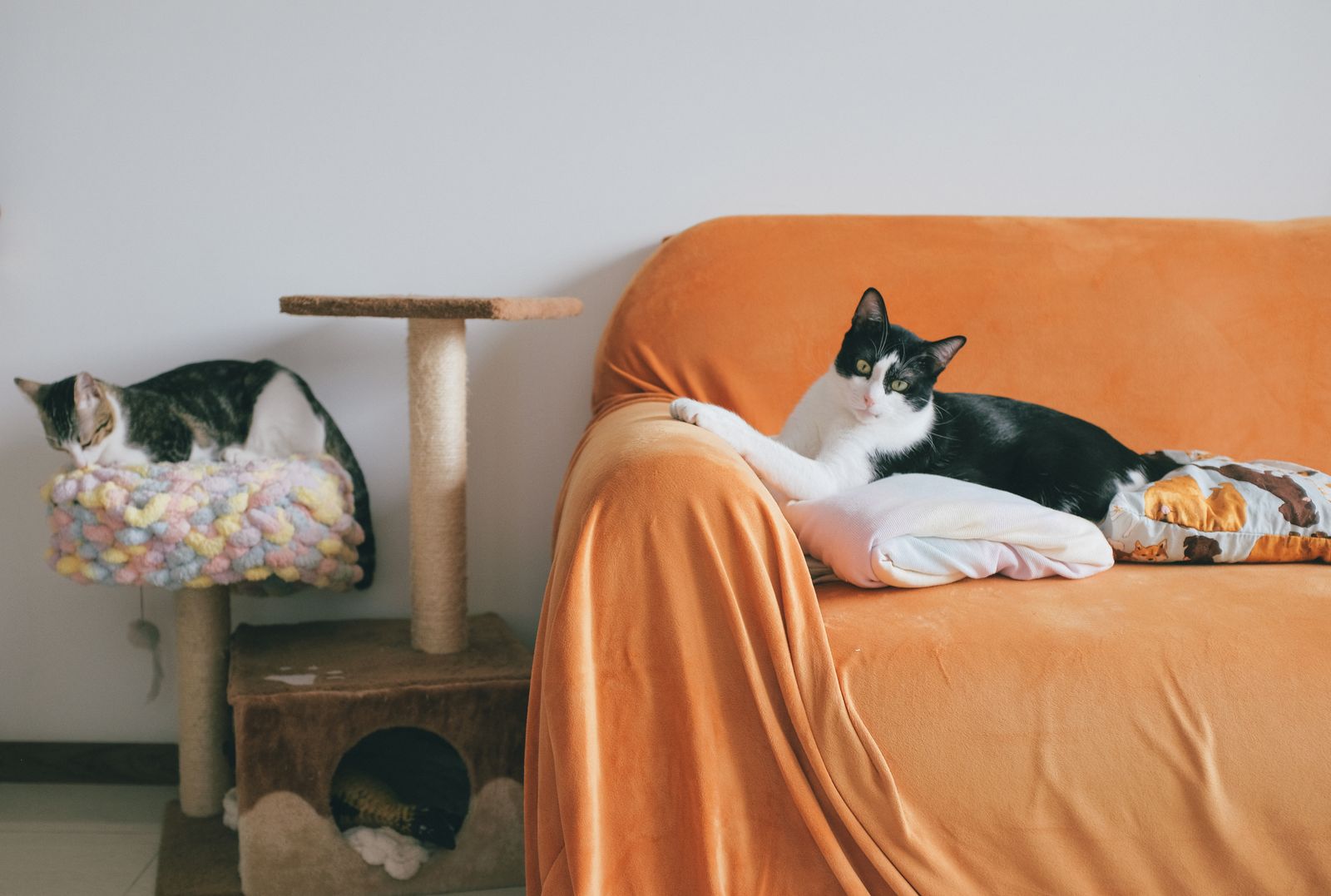
We all know (and dread) the sound of claws ripping into a sofa arm. If you share your home with a cat, there’s a good chance your furniture already wears the evidence.
Here’s the thing: you can’t stop a cat from scratching, and you shouldn’t try. Scratching is a basic feline need. What you can do is change where your cat scratches. The good news is that this is no longer guesswork. Over the past decade, researchers have surveyed thousands of cat owners and run controlled experiments on exactly this problem, and the results point to a clear, kind, and surprisingly design-friendly plan.
The short answer
To stop your cat from scratching furniture:
- Add more scratchers, in more styles. Cats in homes with more (and more varied) scratching options scratch furniture less.
- Put them where your cat already scratches, and near where they sleep and walk.
- Choose materials cats prefer: sisal rope and cardboard beat fabric.
- Make the scratcher irresistible with catnip or silver vine, and reward your cat when they use it.
- Temporarily block or cover the furniture they’ve been targeting.
- Lower stress: short daily play sessions, places to hide and perch.
- Skip punishment entirely. It’s linked to more unwanted scratching, not less.
And whatever you do, don’t declaw. More on why below.
Why do cats scratch?
Scratching isn’t bad behavior. It does several jobs at once:
- Marking territory, by sight and by scent. Cats have glands between their toes that leave a chemical message on whatever they scratch. Scientists call it the feline interdigital semiochemical, and it tells other cats “I was here.” Shredded upholstery is the visual half of that message. This is why cats choose prominent, central spots like the sofa arm or the hallway rug, rather than a scratcher hidden in a corner.
- Claw maintenance. A cat’s claws grow in layers. Scratching pulls off the worn outer sheath and keeps the claws sharp and healthy.
- A full-body stretch. Scratching works the muscles from the paws through the shoulders and back. (I always feel better after a good stretch, too.)
- Emotional release. Cats often scratch when they’re excited, frustrated or stressed, for example when you come home, or after a tense moment with another pet.
Once you understand that scratching is about communication and wellbeing, the solution becomes obvious: give your cat a better place to do it, in a spot that matters to them.
What the research says actually works
The largest study on this question surveyed nearly 2,500 cat owners (Cisneros et al., 2022). Owners who used these strategies reported significantly less unwanted scratching:
- providing additional scratching posts
- restricting access to off-limits furniture
- applying attractants (like pheromones) to the scratcher
- rewarding the cat for using it
- offering sisal rope and flat (horizontal) scratching surfaces
And these were linked to more unwanted scratching: verbal and physical correction. Trimming nails and using nail caps showed no meaningful effect either way.
An earlier survey found the same pattern: unwanted scratching dropped as the number of different types of scratchers in the home went up, punishment didn’t help, and positive reinforcement did (Wilson et al., 2016).
A 2024 study of more than 1,200 cats added an important piece: stress. Cats in homes with children, very playful or highly active cats, and cats more active at night all scratched more. Scratchers placed where cats spend their time worked best, and the researchers recommend several short play sessions over long ones (Salgirli Demirbas et al., 2024). They also noted that owner frustration can raise tension in the home, which can feed the very scratching you’re trying to stop.
Step by step: redirecting scratching from your furniture
1. Offer more scratchers, and mix the styles
One lonely scratching post usually isn’t enough. Aim for at least one scratcher in every room your cat uses a lot, and vary them:
- Vertical: tall posts and wall-mounted scratchers for a full upward stretch
- Horizontal: flat pads and mats on the floor
- Angled: ramps and lounger-style scratchers that work different muscles
If your cat attacks the side of the sofa, they like vertical scratching. If they go for the rug, try horizontal. Match what they already do.
2. Put the scratcher where the damage is
Location matters more than looks (and I say that as someone who cares a lot about looks). Place a scratcher directly in front of or next to the piece your cat targets. Add others near their favorite sleeping spot (cats love a stretch-and-scratch right after a nap) and along the routes they patrol, like the hallway or by the front door.
Once your cat reliably uses the new scratcher, you can move it gradually, a few inches a day, to a spot you prefer.
3. Choose the right material and build
In a controlled study of adult cats, scratchers covered with rope or cardboard got far more use than ones covered in sofa-like fabric (Zhang & McGlone, 2020). A few rules of thumb:
- Stability is non-negotiable. A post that wobbles or tips over once may never be touched again. Look for a heavy, wide base, or mount it securely to the wall.
- Tall enough for a full stretch. Your cat should be able to stretch out completely, front paws up high, without hitting the top.
- Don’t mimic your furniture. If you have carpets you want to protect, skip carpet-covered scratchers. A cat can’t tell why one rug is fine and the other isn’t.
- Sisal fabric vs. sisal rope. Rope wrapped around a post is great for climbing, while flat sisal fabric gives a smoother, continuous scratch. Many cats prefer the fabric for long, satisfying swipes.
- Cardboard is the crowd pleaser. My cats love cardboard: the sound, the shredding, the satisfying mess. It wears out faster, so look for designs with replaceable inserts.
4. Make the scratcher irresistible
Catnip and silver vine both increased how long cats spent scratching and interacting with a scratcher in the Zhang & McGlone study. Rub some into the surface or sprinkle it on a cardboard pad. Not every cat responds to catnip, so if yours shrugs, try silver vine.
Synthetic versions of the scratching pheromone exist too. In a controlled trial, applying a synthetic feline interdigital semiochemical to a post significantly increased scratching on it (Cozzi et al., 2013).
Play is another great lure. Drag a wand toy across and up the scratcher, and your cat will often dig in while chasing it.
5. Reward, never punish
Every time your cat uses the scratcher, give a treat, a little praise or a chin scratch. In the surveys above, rewarding was linked to less furniture scratching, while yelling, spraying water or physical correction were linked to more. Punishment teaches your cat that you’re scary, not that the sofa is off limits, and the extra stress can make scratching worse.
6. Make the furniture less appealing (temporarily)
While the new habit forms, make the target unattractive:
- Block access: close a door, or move a chair or plant in front of the favorite spot.
- Cover it: a throw, a fitted cover, a plastic sheet or double-sided tape on the sofa arm. Most cats dislike the sticky or slippery texture.
- Protect it: a clear furniture guard or an adhesive sisal mat right on the spot. This one doubles as a scratcher.
Always pair a deterrent with a great alternative right next to it. Once your cat has switched over (give it a few weeks), you can remove the covers.
7. Lower stress and add enrichment
Since stress drives scratching, a calmer, richer environment helps:
- Short, frequent play sessions that mimic a hunt: stalk, chase, pounce, “catch,” then a treat.
- Safe hiding spots and high perches, especially in busy homes with kids or other pets. (Read more about why cats like to climb.)
- Predictable routines for meals and play.
Whatever you do, don’t declaw
Declawing isn’t a manicure. It’s the amputation of the last bone of each toe. A study comparing 137 declawed cats with 137 non-declawed cats found that declawed cats had roughly 3 times the odds of back pain, 4.5 times the odds of biting, and 7 times the odds of peeing or pooping outside the litter box (Martell-Moran et al., 2018). In other words, declawing often trades a scratched sofa for much bigger problems.
The American Association of Feline Practitioners strongly opposes elective declawing. It’s banned in the UK and much of Europe, and in the US, New York, Maryland, Virginia, Washington D.C., California, Massachusetts and Rhode Island all prohibit non-medical declawing (ALDF).
Choosing a scratcher that works for your cat and your home
A scratcher your cat ignores is just clutter, and an ugly one is clutter you have to look at. Here’s what I look for:
- Material your cat likes: sisal or cardboard first
- Orientation that matches the habit: vertical, horizontal or angled
- Sturdy: heavy base or wall-mounted
- Big enough for a full stretch
- A design you’re happy to leave in the living room, because that’s exactly where it needs to be
Some favorites by type:
- Cardboard, wall-mounted: this Furhaven two-pack of reversible boards hangs on adhesive pins, so you can cover more than one room without drilling.
- Horizontal: a round cotton rope scratch mat that looks more like a rug than a pet product.
- Lounger: the curved cardboard Catstages Scratch & Groom is a scratcher, a lounger and a self-grooming brush in one.
- On the sofa itself: an adhesive sisal mat protects the spot while giving your cat a legal place to scratch.
For more space-saving options, see my roundup of modern wall-mounted cat scratchers.
FAQ
Why does my cat scratch the furniture right in front of me?
Often because it’s a highly visible spot in a shared space, which is exactly where a cat wants to leave their mark. It can also happen when your cat is excited or wants your attention. Calmly redirect them to a scratcher right next to it, and reward them when they use it, rather than scolding.
How long does it take to redirect a cat’s scratching?
It varies by cat and by how established the habit is. Give a new setup a few weeks before deciding it doesn’t work, and adjust one thing at a time: location first, then material, then attractants.
Do nail caps or nail trims stop scratching?
They don’t stop the urge. In the large 2022 survey they weren’t associated with less unwanted scratching. Regular trims can still reduce damage, but your cat still needs good scratchers.
Is it too late to train an older cat?
No. Cats of any age can learn to use a new scratcher. In fact, the 2022 survey found that cats aged 7 and up had fewer reports of unwanted scratching overall.
Sources
- Cisneros A, Litwin D, Niel L, Stellato AC. Unwanted scratching behavior in cats: influence of management strategies and cat and owner characteristics. Animals, 2022.
- Salgirli Demirbas Y, et al. Evaluating undesired scratching in domestic cats: a multifactorial approach to understand risk factors. Frontiers in Veterinary Science, 2024.
- Wilson C, Bain M, DePorter T, et al. Owner observations regarding cat scratching behavior: an internet-based survey. Journal of Feline Medicine and Surgery, 2016.
- Zhang L, McGlone JJ. Scratcher preferences of adult in-home cats and effects of olfactory supplements on cat scratching. Applied Animal Behaviour Science, 2020.
- Cozzi A, et al. Induction of scratching behaviour in cats: efficacy of synthetic feline interdigital semiochemical. Journal of Feline Medicine and Surgery, 2013.
- Martell-Moran NK, Solano M, Townsend HG. Pain and adverse behavior in declawed cats. Journal of Feline Medicine and Surgery, 2018.