
Cat Wall Shelves: 5 Modern Picks and How to Plan Your Wall
This post contains affiliate links. If you buy through them we may earn a small commission, at no extra cost to you. Learn more.
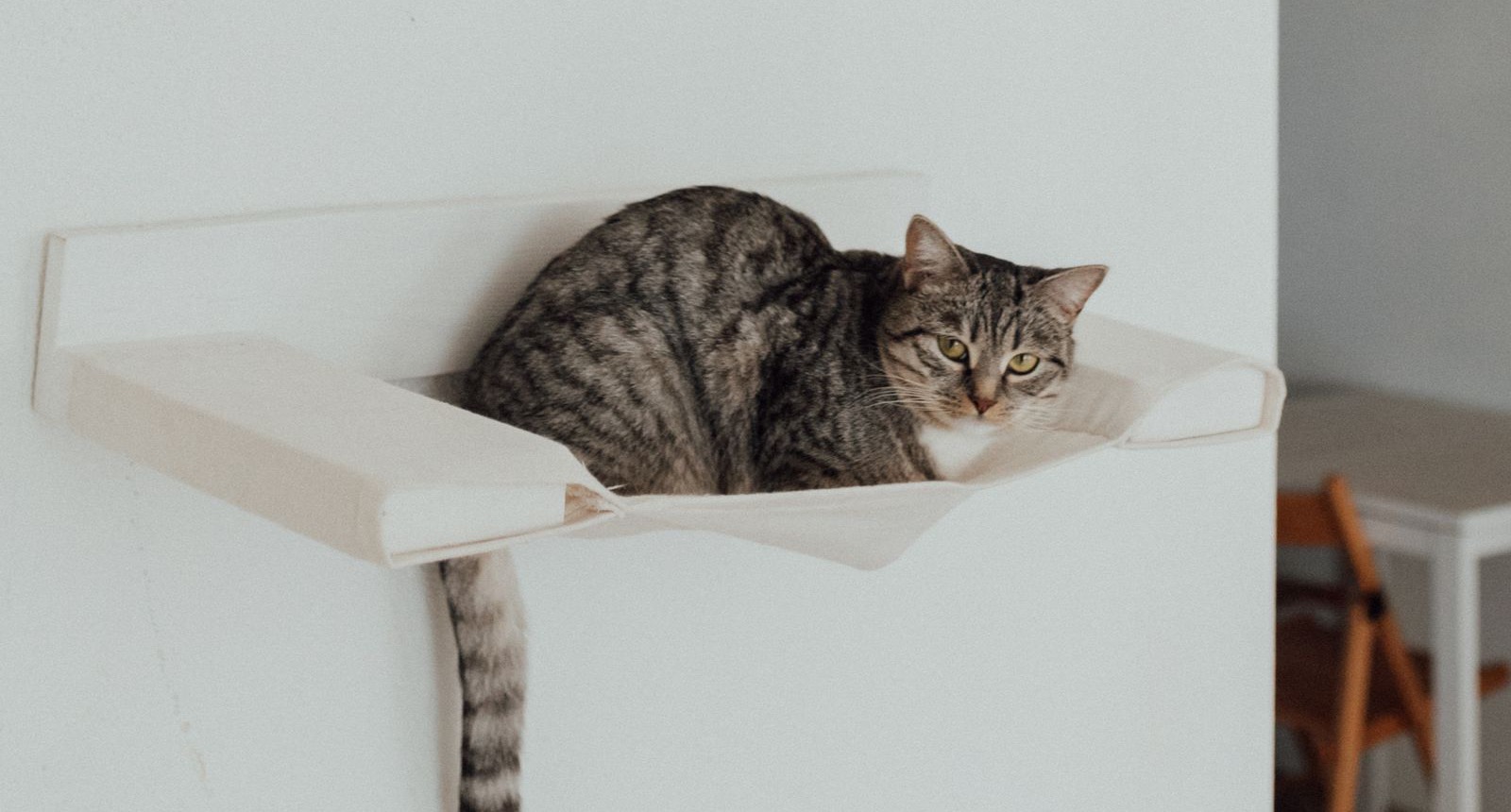
Cat wall shelves give your cat the high ground they crave without a carpeted tower in the middle of your living room. Mounted well, a few shelves turn an empty wall into a climbing route, a lookout and a nap spot, and they can look more like a design feature than pet furniture.
Below are five modern cat wall shelves, from a single sculptural perch to complete sets, followed by how to plan the layout, how to mount it safely and how to get your cat to actually use it.
How I chose these: I read each maker’s product page for materials, size, weight rating and mounting method, and included only shelves sold in the US when I checked in October 2026. I haven’t tested them; the picks are based on those specs and the vet guidelines below.
Why cats want wall shelves
Cats want wall shelves because height makes them feel safe. The AAFP/ISFM Feline Environmental Needs Guidelines, written by a panel of feline vets and behaviorists, list “provide a safe place” as the first pillar of a healthy cat environment and describe that place as “a private and secure area, often in a raised location.” The same guidelines note that an elevated area “increases the cat’s vertical space and allows it to monitor its environment.”
In practice, wall shelves do three things for an indoor cat:
- Safety: a spot above the action where nobody can sneak up on them.
- Territory: more usable space without using any floor, which matters most in small homes and multi-cat households.
- Exercise: jumping and climbing between levels as part of their normal day.
For more on the behavior behind it, see my guide on why cats like to climb to high places.
The best cat wall shelves at a glance
| Shelf | Type | Material | Weight rating | Best for |
|---|---|---|---|---|
| The Refined Feline Lotus Leaf | Single curved perch | Oak veneer over bent plywood | 50 lb | A shelf that looks like art |
| FUKUMARU Two-Platform Shelf | Double perch | Solid rubber wood, sisal mat | Not listed | A natural-wood “tree” on the wall |
| FUKUMARU Small Climbing Shelf | Step | Solid wood | Not listed | Building a staircase between perches |
| NOVGOBHOT 9-Piece Set | Complete system | Wood, sisal, condo | 25 lb per perch | A full climbing wall in one box |
| Coziwow 5-Piece Climber Set | Starter set | Particle board, plush fabric | 22 lb | Trying a cat wall on a budget |
Modular cat shelves: single perches and steps
The Refined Feline Lotus Leaf Cat Shelf
If you only add one shelf, make it one you are happy to look at. The Lotus Leaf Cat Shelf is a single curved perch, 22 inches long and 10.5 inches deep, made of oak veneer over bent plywood, so it reads as a wall sculpture with a cat in it. The carpet on top attaches with a hook-and-loop backing and can be replaced when it wears out.
It is rated to hold up to 50 pounds, and its screw holes are 16 inches apart, which matches standard wall stud spacing. The brand also makes a matching 60-inch Lotus Branch shelf if you want to extend it into a catwalk later.
Good to know: The curve is the point. The AAFP/ISFM guidelines note that “a hammock-style dip in the middle of the perch or shelf will aid the cat’s sense of feeling hidden.”
Watch out for: It is a single perch, so most cats will need a step or a piece of furniture to reach it.
FUKUMARU Two-Platform Cat Wall Shelf
For a warmer, natural-wood look, the FUKUMARU two-platform shelf is shaped like a small tree with two large platforms, so a big cat can stretch out on either one. It is made of thick solid rubber wood with a protective wax finish, and one platform has a natural sisal mat, so it doubles as a scratching spot.
It is designed for 16-inch stud spacing; the maker recommends fixing both sides into studs for the most stability.
Good to know: Use two of these at different heights with small steps between them to build a corner climbing route.
Watch out for: It is most stable with both sides fixed into studs 16 inches apart, which limits where it can go.
FUKUMARU Small Climbing Shelf
Every good cat wall needs steps, and this small climbing shelf is a simple, solid-wood one. The board is about 15.7 inches long and 7.8 to 8.4 inches deep: too small to nap on, which is exactly right for a step. It installs with the screws and wall anchors in the box, and its plain wood finish works next to most perches.
Good to know: Steps are what make a wall usable for kittens, seniors and heavier cats. Add more steps rather than bigger jumps.
Watch out for: It is a step, not a resting spot, so it needs a perch at the end of the route.
Complete cat wall shelf sets
NOVGOBHOT 9-Piece Cat Wall Shelves Set
If you would rather buy the whole system at once, the NOVGOBHOT set comes with nine pieces: climbing shelves, steps, a condo to hide in and sisal scratching posts. It is made of thick wood with clean lines, rounded edges and a warm finish, and each perch is rated for up to 25 pounds.
Good to know: A full set is easier to plan than mixing brands, but lay all nine pieces out on the floor first and photograph the arrangement before you drill.
Watch out for: Each perch is rated for 25 pounds, half the Lotus Leaf’s rating, and nine pieces mean many holes in one wall.
Coziwow 5-Piece Wall-Mounted Cat Climber Set
For a lower-cost way to try a cat wall, the Coziwow 5-piece climber set combines a shelf, a wall bridge, a scratching board, steps and a wall-mounted condo. It is made of half-inch particle board covered in plush fabric, comes with the mounting hardware, and is sold in beige or gray.
Good to know: Start with this as a short route by a window, then add single shelves as you learn where your cat likes to go.
Watch out for: Each piece is rated for up to 22 pounds, the lowest rating in this list, and it is the only pick made of particle board rather than wood. Leave a margin if you have a large cat.
How to plan your cat wall
- Start where your cat already goes. The top of the bookcase, the window, the back of the sofa: put the destination perch there, and build the route toward it.
- Build a staircase, not a ladder. Several small steps beat a few big jumps, especially for kittens, older cats and cats with stiff joints.
- Give every route a way down. The vet guidelines say a safe place in a multi-cat home “should have more than one entry so that access cannot be easily blocked by another cat.”
- Make the top spot big enough to lie on. Steps can be small, but the guidelines say perches “should be wide enough and long enough to allow the cat to fully stretch.”
- Lay it out first. Use painter’s tape or paper cutouts on the wall, live with it for a day, then drill.
Mounting cat shelves safely
- Find the studs. The Lotus Leaf and the FUKUMARU two-platform shelf are both designed for studs 16 inches apart, the standard spacing in most US homes. A cheap stud finder pays for itself here.
- Use the right anchors when there is no stud. Use the anchors that come with the shelf, or stronger ones, and stay well within its weight rating.
- Check the rating against your cat at full speed. A cat landing from a jump puts more force on a shelf than a cat sitting still, so leave a margin.
- Test it yourself first. Press down hard on each shelf before your cat gets to it. If it shifts, fix it before your cat uses it.
If you rent and cannot drill, a floor-standing cat tree near a window gives your cat height without touching the walls.
How do I get my cat to use wall shelves?
Put the shelves where your cat already wants to be, and make the first step easy.
- Give it a view. The AAFP/ISFM guidelines say indoor resting areas such as a perch “should include a location that allows the cat visibility of the outdoors,” so end the route at a window.
- Keep it reachable. For kittens and older cats, the guidelines advise placing perches and shelves “at a relatively low height or at levels that can be reached via ramps.”
- Start from furniture they already use. Put the first step next to the sofa, bookcase or windowsill your cat already jumps onto, so the route continues a path they know.
Want something custom?
For a fully custom, handmade wall in solid wood, Catastrophic Creations builds shelves, bridges and perches designed to be combined into larger cat walls. It costs more than the sets above, and it is a different kind of purchase: furniture you plan around your room.
FAQ
How high should cat wall shelves be?
Put the top perch where your cat already likes to be, often near the ceiling or beside a high window, and work downward with steps. The first step should be an easy jump from the floor or a piece of furniture.
How far apart should cat shelves be?
Close enough that your cat can step or hop between them without a long leap. Use the jumps your cat already makes at home, such as sofa to windowsill, as a guide, and add a step wherever a jump looks hard.
How many cat shelves do I need?
The AAFP/ISFM guidelines say there should be “at least as many safe places, sized to hold a single cat, as there are cats in a household,” in areas separated from each other. They also recommend at least two resting areas for every cat, so even one cat should have two perches it can lie on, joined by enough steps to reach them comfortably.
Are cat wall shelves safe?
Yes, when they are fixed into studs or rated anchors and used within their weight limits. Watch older cats and kittens on new routes, and add steps if a jump looks hard for them.
Do cat shelves damage walls?
They need screws, so expect small holes to fill if you move. If that is a problem, choose a floor-standing tree instead.
For more ways to give your cat height and a place to scratch, see my roundup of modern wall-mounted cat scratchers.
Sources
- Ellis SLH, Rodan I, Carney HC, et al. AAFP and ISFM feline environmental needs guidelines. Journal of Feline Medicine and Surgery, 2013.